Tuesday, October 7, 2008

18W Audio Amplifier

|0 comments

18W Audio Amplifier


High Quality very simple unit

No need for a preamplifier


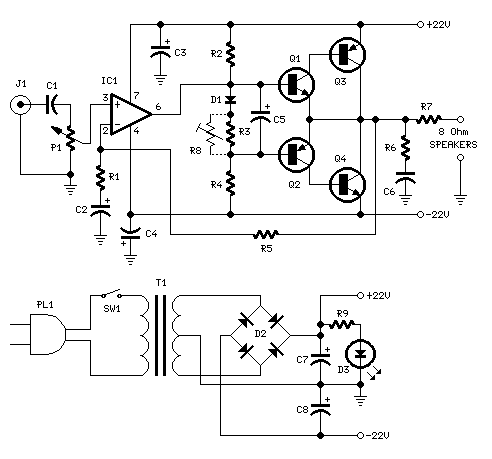
Circuit diagram:

18 Watt Amplifier

Amplifier parts:

P1_____________22K  Log. Potentiometer (Dual-gang for stereo)

R1______________1K 1/4W Resistor
R2______________4K7 1/4W Resistor
R3____________100R 1/4W Resistor
R4______________4K7 1/4W Resistor
R5_____________82K 1/4W Resistor
R6_____________10R 1/2W Resistor
R7_______________R22 4W Resistor (wirewound)
R8______________1K 1/2W Trimmer Cermet (optional)

C1____________470nF 63V Polyester Capacitor
C2,C5_________100µF 3V Tantalum bead Capacitors
C3,C4_________470µF 25V Electrolytic Capacitors
C6____________100nF 63V Polyester Capacitor

D1___________1N4148 75V 150mA Diode

IC1________TLE2141C Low noise, high voltage, high slew-rate Op-amp

Q1____________BC182 50V 100mA NPN Transistor
Q2____________BC212 50V 100mA PNP Transistor
Q3___________TIP42A 60V 6A PNP Transistor
Q4___________TIP41A 60V 6A NPN Transistor

J1______________RCA audio input socket

Power supply parts:

R9______________2K2 1/4W Resistor

C7,C8________4700µF 25V Electrolytic Capacitors

D2_____________100V 4A Diode bridge
D3_____________5mm. Red LED

T1_____________220V Primary, 15 + 15V Secondary, 50VA Mains transformer

PL1____________Male Mains plug

SW1____________SPST Mains switch

Notes:

  • Can be directly connected to CD players, tuners and tape recorders.
  • Do not exceed 23 + 23V supply.
  • Q3 and Q4 must be mounted on heatsink.
  • D1 must be in thermal contact with Q1.
  • Quiescent current (best measured with an Avo-meter in series with Q3 Emitter) is not critical.
  • Adjust R3 to read a current between 20 to 30 mA with no input signal.
  • To facilitate quiescent current setting add R8 (optional).
  • A correct grounding is very important to eliminate hum and ground loops. Connect to the same point the ground sides of J1, P1, C2, C3 & C4. Connect C6 to the output ground.
  • Then connect separately the input and output grounds to the power supply ground.

Technical data:

Output power:
18 Watt RMS into 8 Ohm (1KHz sine wave)
Sensitivity:
150mV input for 18W output
Frequency response:
30Hz to 20KHz -1dB
Total harmonic distortion @ 1KHz:
0.1W 0.02% 1W 0.01% 5W 0.01% 10W 0.03%
Total harmonic distortion @10KHz:
0.1W 0.04% 1W 0.05% 5W 0.06% 10W 0.15%
Unconditionally stable on capacitive loads

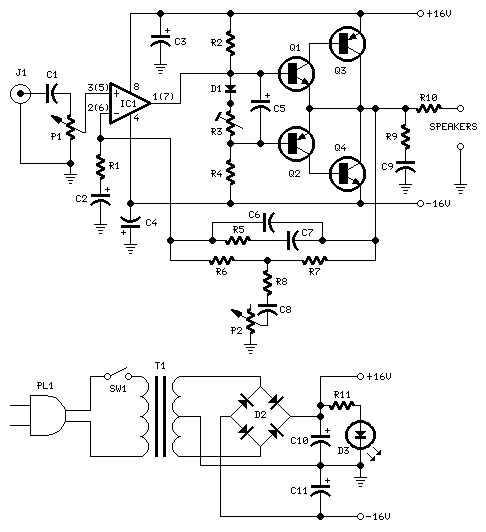
10W Audio Amplifier with Bass-boost

|0 comments

High Quality, very simple design

No preamplifier required


Circuit diagram:

10W Amplifier

Parts:

P1_________________22K   Log.Potentiometer (Dual-gang for stereo)
P2________________100K Log.Potentiometer (Dual-gang for stereo)
R1________________820R 1/4W Resistor
R2,R4,R8____________4K7 1/4W Resistors
R3________________500R 1/2W Trimmer Cermet
R5_________________82K 1/4W Resistor
R6,R7______________47K 1/4W Resistors
R9_________________10R 1/2W Resistor
R10__________________R22 4W Resistor (wirewound)

C1,C8_____________470nF 63V Polyester Capacitor
C2,C5_____________100µF 25V Electrolytic Capacitors
C3,C4_____________470µF 25V Electrolytic Capacitors
C6_________________47pF 63V Ceramic or Polystyrene Capacitor
C7_________________10nF 63V Polyester Capacitor
C9________________100nF 63V Polyester Capacitor

D1______________1N4148 75V 150mA Diode

IC1_____________NE5532 Low noise Dual Op-amp

Q1_______________BC547B 45V 100mA NPN Transistor
Q2_______________BC557B 45V 100mA PNP Transistor
Q3_______________TIP42A 60V 6A PNP Transistor
Q4_______________TIP41A 60V 6A NPN Transistor

J1__________________RCA audio input socket

Power supply parts:

R11_________________1K5  1/4W Resistor

C10,C11__________4700µF 25V Electrolytic Capacitors

D2________________100V 4A Diode bridge
D3________________5mm. Red LED

T1________________220V Primary, 12 + 12V Secondary 24-30VA Mains transformer

PL1_______________Male Mains plug

SW1_______________SPST Mains switch

Comments:

This design is based on the 18 Watt Audio Amplifier, and was developed mainly to satisfy the requests of correspondents unable to locate the TLE2141C chip. It uses the widespread NE5532 Dual IC but, obviously, its power output will be comprised in the 9.5 - 11.5W range, as the supply rails cannot exceed ±18V.
As amplifiers of this kind are frequently used to drive small loudspeaker cabinets, the bass frequency range is rather sacrificed. Therefore a bass-boost control was inserted in the feedback loop of the amplifier, in order to overcome this problem without quality losses. The bass lift curve can reach a maximum of +16.4dB @ 50Hz. In any case, even when the bass control is rotated fully counterclockwise, the amplifier frequency response shows a gentle raising curve: +0.8dB @ 400Hz, +4.7dB @ 100Hz and +6dB @ 50Hz (referred to 1KHz).

Notes:

  • Can be directly connected to CD players, tuners and tape recorders.
  • Schematic shows left channel only, but C3, C4, IC1 and the power supply are common to both channels.
  • Numbers in parentheses show IC1 right channel pin connections.
  • A log type for P2 will ensure a more linear regulation of bass-boost.
  • Do not exceed 18 + 18V supply.
  • Q3 and Q4 must be mounted on heatsink.
  • D1 must be in thermal contact with Q1.
  • Quiescent current (best measured with an Avo-meter in series with Q3 Emitter) is not critical.
  • Set the volume control to the minimum and R3 to its minimum resistance.
  • Power-on the circuit and adjust R3 to read a current drawing of about 20 to 25mA.
  • Wait about 15 minutes, watch if the current is varying and readjust if necessary.
  • A correct grounding is very important to eliminate hum and ground loops. Connect to the same point the ground sides of J1, P1, C2, C3 &C4. Connect C9 to the output ground.
  • Then connect separately the input and output grounds to the power supply ground.

Technical data:

Output power:
10 Watt RMS into 8 Ohm (1KHz sinewave)
Sensitivity:
115 to 180mV input for 10W output (depending on P2 control position)
Frequency response:
See Comments above
Total harmonic distortion @ 1KHz:
0.1W 0.009% 1W 0.004% 10W 0.005%
Total harmonic distortion @ 100Hz:
0.1W 0.009% 1W 0.007% 10W 0.012%
Total harmonic distortion @ 10KHz:
0.1W 0.056% 1W 0.01% 10W 0.018%
Total harmonic distortion @ 100Hz and full boost:
1W 0.015% 10W 0.03%
Max. bass-boost referred to 1KHz:
400Hz = +5dB; 200Hz = +7.3dB; 100Hz = +12dB; 50Hz = +16.4dB; 30Hz = +13.3dB
Unconditionally stable on capacitive loads

20W LM1875 Audio Amplifier

|0 comments
20W LM1875 Audio Amplifier

Description:
The LM1875 is a 20W 5-pin audio amplifier chip made by National Semiconductor. It can produce a peak power of 30W, and is designed for applications in which you need a moderate power, high fidelity amplifier.

Schematic:


PCB / Connections:

This PCB is NOT drawn to scale! It is to be used for a preview only. To make your PCB, download the Eagle files and print those!


Usage:
Build a power supply using the Gainclone Power Supply in the Schematics section, and connect it to the appropriate pads on the PCB. Folow the instructions on the image above to connect the input source, speaker, power supply, and all the components.

As always, test the amp with a cheap speaker that damage to it will not cost much to replace, and once it works properly, go ahead and connect your speakers to it. This amplifier is rated to drive a 4 or 8 ohm speaker. It is reccomended to only power a 4-ohm speaker on a +/-25V power supply. Only use a +/-30V power source to maximize output power with an 8-ohm speaker.

60W MosFet Audio Amplifier

|0 comments

60W MosFet Audio Amplifier


High Quality, powerful unit: 90W into 4 Ohm load

Also suited as guitar or bass amplifier


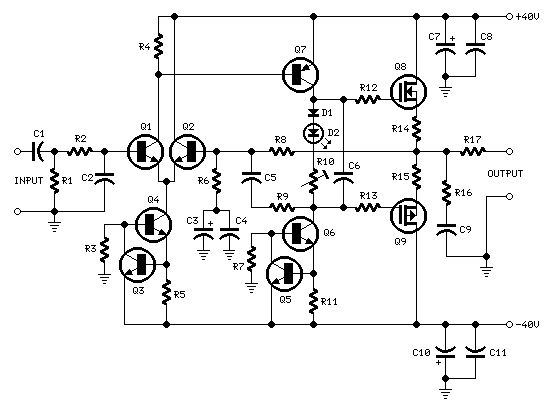
Circuit diagram:

60 Watt MosFet Amplifier

Parts:

R1______________47K   1/4W Resistor
R2_______________4K7 1/4W Resistor
R3______________22K 1/4W Resistor
R4_______________1K 1/4W Resistor
R5,R12,R13_____330R 1/4W Resistors
R6_______________1K5 1/4W Resistor
R7______________15K 1/4W Resistor
R8______________33K 1/4W Resistor
R9_____________150K 1/4W Resistor
R10____________500R 1/2W Trimmer Cermet
R11_____________39R 1/4W Resistor
R14,R15___________R33 2.5W Resistors
R16_____________10R 2.5W Resistor
R17_______________R22 5W Resistor (wirewound)

C1_____________470nF 63V Polyester Capacitor
C2_____________470pF 63V Polystyrene or ceramic Capacitor
C3______________47µF 63V Electrolytic Capacitor
C4,C8,C9,C11___100nF 63V Polyester Capacitors
C5______________10pF 63V Polystyrene or ceramic Capacitor
C6_______________1µF 63V Polyester Capacitor
C7,C10_________100µF 63V Electrolytic Capacitors

D1___________1N4002 100V 1A Diode
D2_____________5mm. Red LED

Q1,Q2,Q4_____MPSA43 200V 500mA NPN Transistors
Q3,Q5________BC546 65V 100mA NPN Transistors
Q6___________MJE340 200V 500mA NPN Transistor
Q7___________MJE350 200V 500mA PNP Transistor
Q8___________IRFP240 200V 20A N-Channel Hexfet Transistor
Q9___________IRFP9240 200V 12A P-Channel Hexfet Transistor

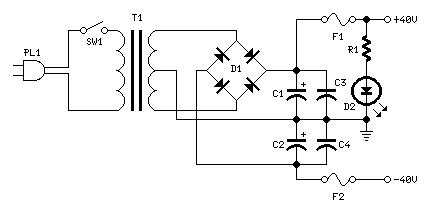
Power supply circuit diagram:

60 Watt MosFet Amplifier Power Supply

Parts:

R1_______________3K9   1W Resistor

C1,C2_________4700µF 63V Electrolytic Capacitors (See Notes)
C3,C4__________100nF 63V Polyester Capacitors

D1_____________400V 8A Diode bridge
D2_____________5mm. Red LED

F1,F2__________4A Fuses with sockets

T1_____________230V or 115V Primary, 30+30V Secondary
160VA Mains transformer

PL1____________Male Mains plug

SW1____________SPST Mains switch

Comments:

To celebrate the hundredth design posted to this website, and to fulfil the requests of many correspondents wanting an amplifier more powerful than the 25W MosFet, a 60 - 90W High Quality power amplifier design is presented here.
Circuit topology is about the same of the above mentioned amplifier, but the extremely rugged IRFP240 and IRFP9240 MosFet devices are used as the output pair, and well renowned high voltage Motorola's transistors are employed in the preceding stages.
The supply rails voltage was kept prudentially at the rather low value of + and - 40V. For those wishing to experiment, the supply rails voltage could be raised to + and - 50V maximum, allowing the amplifier to approach the 100W into 8 Ohm target: enjoy!
A matching, discrete components, Modular Preamplifier design is available here: Modular Audio Preamplifier.

Notes:

  • In the original circuit, a three-diode string was wired in series to R10. Two of these diodes are now replaced by a red LED in order to achieve improved quiescent current stability over a larger temperature range. Thanks to David Edwards of LedeAudio for this suggestion.
  • A small, U-shaped heatsink must be fitted to Q6 & Q7.
  • Q8 & Q9 must be mounted on large heatsinks.
  • Quiescent current can be measured by means of an Avo-meter wired in series to the positive supply rail and no input signal.
  • Set the Trimmer R10 to its minimum resistance.
  • Power-on the amplifier and adjust R10 to read a current drawing of about 120 - 130mA.
  • Wait about 15 minutes, watch if the current is varying and readjust if necessary.
  • The value suggested for C1 and C2 in the Power Supply Parts List is the minimum required for a mono amplifier. For optimum performance and in stereo configurations, this value should be increased: 10000µF is a good compromise.
  • A correct grounding is very important to eliminate hum and ground loops. Connect to the same point the ground sides of R1, R3, C2, C3 and C4 and the ground input wire. Connect R7 and C7 to C11 to output ground. Then connect separately the input and output grounds to the power supply ground.

Technical data:

Output power:
60 Watt RMS @ 8 Ohm (1KHz sinewave) - 90W RMS @ 4 Ohm
Sensitivity:
1V RMS input for 58W output
Frequency response:
30Hz to 20KHz -1dB
Total harmonic distortion @ 1KHz:
1W 0.003% 10W 0.006% 20W 0.01% 40W 0.013% 60W 0.018%
Total harmonic distortion @10KHz:
1W 0.005% 10W 0.02% 20W 0.03% 40W 0.06% 60W 0.09%
Unconditionally stable on capacitive loads
CAR Power Amplifier

|0 comments
CAR Power Amplifier Circuit page 01 :
TDA2005 Amplifier Car audio BCL 20W
(with PCB)

circuit TDA2005 Amplifier Car audio BCL 20W

The Circuit TDA2005 Amplifier for Car audio BCL (?Bride Amplifier) 20W.
Volt supply 11V to 14V, Power output 10W+10W#, for Speaker 2-8 ohm.


PCB TDA2005 Amplifier Car audio BCL 20W

555 Timer Circuit

Power Supply

Electronic Circuit Designer.